


Table of contents · 7 min read
- Do you still need to sterilize baby bottles?
- Bottle washer, sterilizer or dishwasher: what is the difference?
- The benefits of a bottle washer
- The limits to know before you buy
- How to choose a bottle washer
- Our NOLIA bottle washer in detail
- So, is a bottle washer worth it?
- FAQ: bottle washers and sterilizing
Six to eight bottles a day in the first months, as many nipples and rings, sometimes breast pump parts on top: washing up after baby can easily take an hour a day. That is why bottle washers have become so popular. But is one more appliance on the counter, at over 200 €, really worth it?
The short answer: yes if you give several bottles a day or pump your milk, because it washes, steam sterilizes and dries everything in a single cycle. No if your baby only has the occasional bottle: a good wash in hot water, a clean drying rack and, if needed, a simple sterilizer are enough.
Do you still need to sterilize baby bottles?
This is the first question to ask, because it changes everything. French health guidance has changed: sterilizing is no longer mandatory as long as bottles are carefully washed and prepared with clean hands. It is still often advised for the first three months, while baby's defenses develop, and is usually stopped around 4 to 5 months, when baby starts putting everything in their mouth.
What really matters is cleaning, after every bottle:
- empty any leftover milk and rinse with cold water straight away
- take the bottle fully apart: body, ring, nipple, cap
- wash in hot water with dish soap and a clean bottle brush, or in the dishwasher on a cycle of at least 65 °C (149 °F)
- rinse, then leave to air dry upside down, without wiping with a dish towel
- store clean bottles covered, away from dirty dishes
For a premature, sick or fragile baby, ask your pediatrician: stricter precautions may apply.
Bottle washer, sterilizer or dishwasher: what is the difference?
These three options do not do the same job. An electric or microwave sterilizer steams bottles that have already been washed by hand. A dishwasher washes, but small parts get lost in the basket, nipples can be damaged by the heat, and you have to wait until it is full. A bottle washer does everything in one dedicated appliance.
| Option | Washing | Steam | Drying | Budget |
|---|---|---|---|---|
| Hand washing | By hand | No | Drying rack | A few euros |
| Steam sterilizer | By hand | Yes | Depends on model | 30 to 80 € |
| Dishwasher | Automatic, with other dishes | No | Depends on cycle | Already owned |
| 4-in-1 bottle washer | Automatic, dedicated | Yes | Hot air | 200 to 400 € |
The benefits of a bottle washer
Time saved every day
No more bottle brush, no more overflowing drying rack, no more pan of boiling water. You rinse, load, start the program, and find your bottles clean and dry. With six bottles a day, that is easily three to five hours saved every week.
Consistent hygiene, even at 3 a.m.
When you are tired, you sometimes wash a little faster. The machine always runs the same cycle: hot water wash, steam, full drying. That last step is often underestimated, since water left in a poorly dried bottle encourages bacteria.
Everything in one place, ready to use
Bottles, nipples, rings and breast pump parts stay stored in the closed appliance. The most complete models keep them clean for several hours, or even several days, without running another cycle.
A real help if you pump
If you pump your milk, flanges, valves and membranes add to the bottles. This is often where a bottle washer makes the biggest difference.
The limits to know before you buy
- The price. Expect to pay between 200 and 400 €, compared with 30 to 80 € for a sterilizer alone.
- The space. You need a spot on the counter near an outlet, and somewhere to empty the waste water.
- Consumables. Most models need dedicated detergent tablets, which you will have to buy again.
- Limited time of use. It is mainly useful during the bottle period, often the first 12 to 18 months. It pays off better with a second child, and it resells easily second hand.
- It does not replace good habits. Rinsing the bottle after the feed and washing your hands before preparing it remain essential.
How to choose a bottle washer
- Capacity. Aim for at least 6 bottles, ideally enough for a whole day without running another cycle.
- Room for pump parts. If you pump, check that the breast pump parts have their own place.
- Installation. A model with a water tank and no water connection can go anywhere. A plumbed-in model has to sit near the sink.
- Programs. A quick cycle for everyday use, a long cycle for thickened milk or purée, and a steam-only mode for parts that are already clean.
- Drying and storage. The longer the appliance keeps bottles clean, the fewer cycles you run.
- Running costs. Price of tablets, water use, and an optional filter for hard water.
- Compatibility. Glass, plastic or silicone bottles, wide or narrow neck: check the instructions for both your bottles and the machine.
Our NOLIA bottle washer in detail
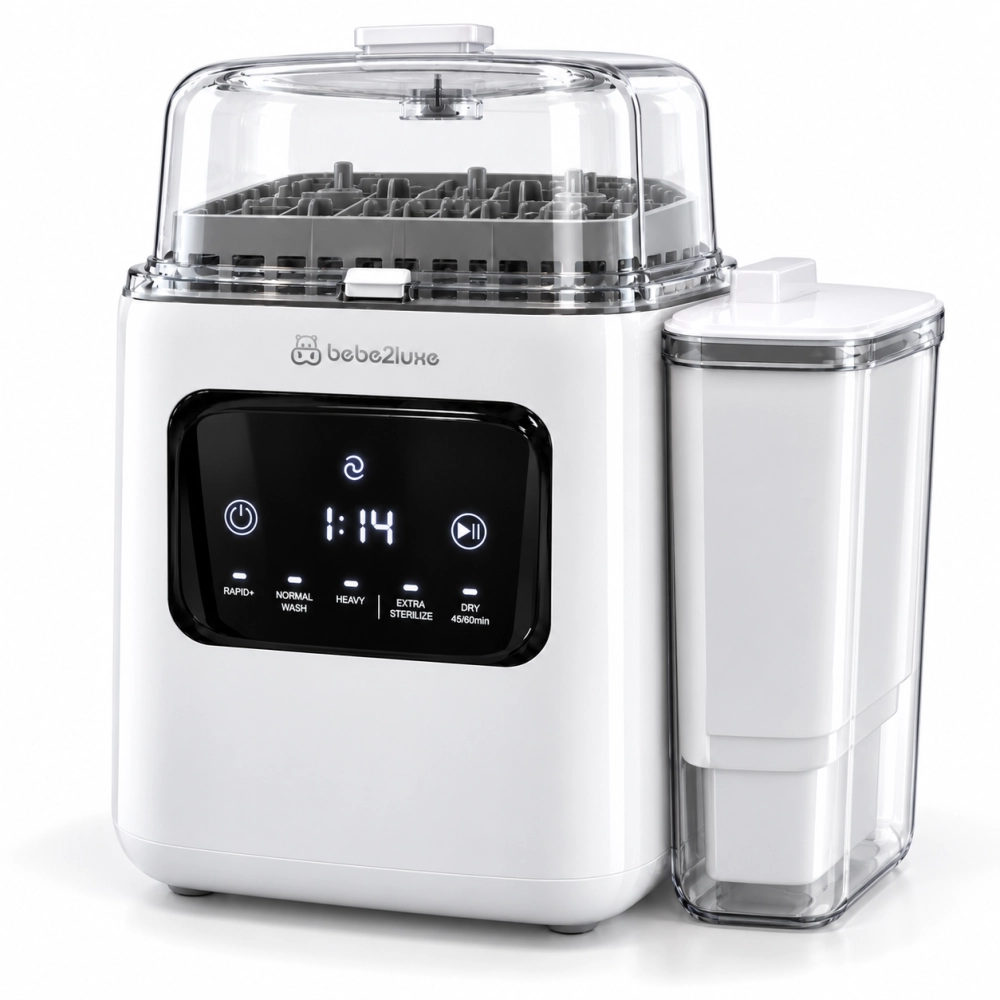
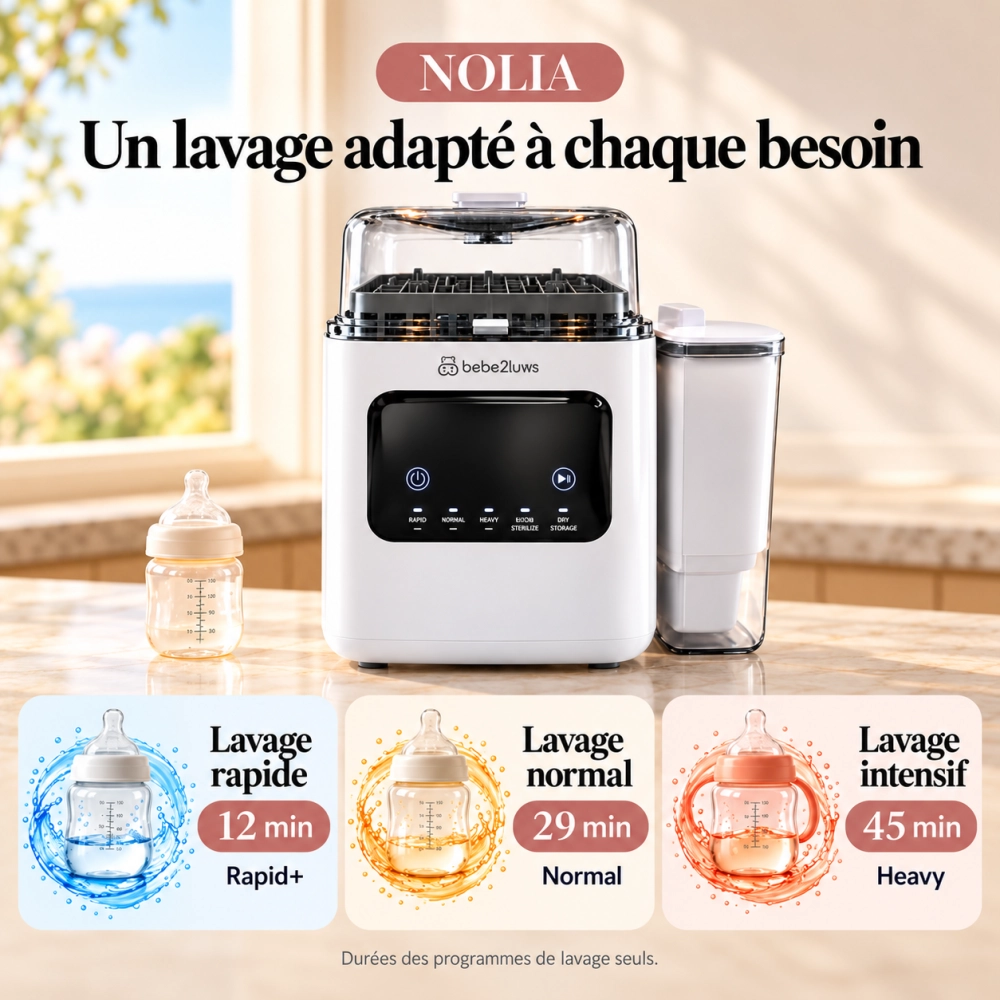
We designed the NOLIA bottle washer, sterilizer and dryer to handle a full day of bottles, with no complicated installation. It combines four functions: washing, steam sterilizing, drying and clean storage for up to 72 hours.
View the product page: NOLIA →
- Capacity: up to 8 bottles and 2 breast pump sets per cycle.
- Wash programs: Rapid+ (12 minutes), Normal (29 minutes) and Heavy (45 minutes).
- Steam: an 8-minute sterilizing cycle, added to the wash or run on its own.
- Drying: 45 or 60 minutes of hot air.
- Water: built-in 5-liter tank, about 3 liters per wash, no water connection, drain hose included. A filter kit is available as an option.
- Dimensions: 31 × 38.4 × 43.4 cm, weight 9.3 kg.
One important point: NOLIA must only be used with BEBE2LUXE detergent tablets, never with dish soap or regular dishwasher tablets, which foam or leave residue.
In practice, after the feed you rinse the bottle in cold water, take it apart and place it in the basket. In the evening, run a Normal cycle with steam and drying, and the next morning everything is ready for the day.
View the product page: NOLIA →
Getting ready for baby's arrival? NOLIA is a great item for a baby registry: see our method in how to plan your baby registry, and the right time for each purchase in our month-by-month baby shopping calendar.
So, is a bottle washer worth it?
Yes, if:
- your baby has at least 4 to 5 bottles a day
- you pump your milk regularly
- you are expecting twins or a second child
- you do not have a dishwasher, or it is already running at full capacity
Less useful, if:
- you breastfeed without pumping and bottles are occasional
- you are really short of space in your kitchen
- your baby is already over 6 months old and will soon move to a cup and spoon
And when it is time to start solids, the high chair takes over: our guide on how to choose a high chair will help you prepare for this step.
FAQ: bottle washers and sterilizing
Until what age should you sterilize baby bottles?
Sterilizing is no longer mandatory if bottles are washed properly. It is often advised for the first three months, then stopped around 4 to 5 months. For a premature or fragile baby, follow your pediatrician's advice.
Does a bottle washer replace a sterilizer?
Yes, if it has a steam function like NOLIA: it washes, steams and dries in the same appliance. A bottle washer without steam only washes.
Can you wash baby bottles in the dishwasher?
Yes, on a cycle of at least 65 °C (149 °F), after rinsing them. Rubber nipples do not handle heat well, so it is better to wash them by hand.
Can you put glass bottles in a bottle washer?
Check the instructions for your bottles and for the machine before the first cycle. Plastic, glass and silicone bottles do not all react to heat in the same way.
How much water does a bottle washer use?
It depends on the model. NOLIA uses about 3 liters per wash, taken from its 5-liter tank, with no connection to the tap.
How long do bottles stay clean in the machine?
With NOLIA, up to 72 hours with the appliance closed. Once taken out, use them quickly, and always prepare the milk just before the feed.
Sources: Santé.fr and mpedia (French Association of Ambulatory Pediatrics), “Cleaning and sterilizing baby bottles and nipples”; Afssa (French food safety agency), “Hygiene recommendations for preparing and storing baby bottles”. This article gives general guidance and does not replace your doctor's advice.

Silicone Squeeze Feeding Bottle with Spoon
- Food grade silicone
- Integrated spoon
- Perfect dosage


SPLITY 2 – 3-in-1 Convertible High Chair, Bouncer & Baby Swing
- Lounger,Electric swing
- High chair with tray
- Save space and money