


Contents · 9 min read
For the first few months, milk is all your baby needs. Then comes the day when your baby watches your plate with interest, and you start wondering: is it time? What do we start with? How many spoonfuls? And what about eggs, peanuts, gluten, should we wait? The guidelines have changed a lot in recent years, and what our parents learned no longer always applies.
The short answer: start between 4 and 6 months completed, never before 4 months and no later than 6 months. All food groups can be offered from the start, including egg, peanut (as powder or smooth butter) and gluten, first as a smooth purée and in very small amounts. Milk remains the main food, you add a small spoonful of oil, and you add no salt, no sugar and no honey.
When should you start solid foods?
The current French guidelines, published by Santé publique France (the French public health agency) based on the opinions of the food safety agency Anses and the High Council for Public Health, set a clear window: between 4 and 6 months completed.
- Not before 4 months: your baby's digestive system and kidneys are not ready.
- Not after 6 months: from this age, milk alone no longer covers all their needs, especially for iron.
- In between: you choose the moment, by watching your child and talking it over with your doctor or health visitor.
If you are breastfeeding, the window is the same: solid foods can start between 4 and 6 months, and breastfeeding continues on demand, for as long as you wish. For a baby born prematurely, ask your paediatrician before you start: the timing is often based on their corrected age.
Signs your baby is ready
Age is not everything. These signs usually show that your baby is ready to discover the spoon:
- they hold their head up well, without support;
- they are interested in what you eat, follow your fork with their eyes, put objects in their mouth;
- they open their mouth when the spoon comes near, instead of always pushing it out with their tongue;
- they still seem hungry after their usual breastfeeds or bottles.
Don't panic if they pull a face at the first spoonfuls: it's a discovery, not a test.
What foods to start with
This is the big change in the latest guidelines: there is no longer a set order. You can start with vegetables, fruit, starchy foods, meat, fish or egg, as long as everything is well cooked and blended into a smooth purée.
Allergenic foods: no longer delayed
Egg, peanut, tree nuts, fish or gluten can be offered from the very start of solid foods, between 4 and 6 months. We now know that delaying these foods does not prevent allergies, and that tasting them early actually helps children tolerate them. Two precautions:
- the form: peanuts and tree nuts only as a fine powder or smooth butter mixed into another food, never whole or in pieces, because of the choking risk;
- family history: if there are food allergies in the family or if your baby has severe eczema, talk to your doctor before introducing them.
A simple base for the first meals
- Vegetables steamed or boiled, without salt, blended very smooth. To bind, about a quarter of starchy food (potato, rice, pasta) to three quarters vegetables.
- Fruit very ripe or cooked, as a smooth compote, with no added sugar.
- A small amount of protein (meat, fish, hard-boiled egg), well cooked and blended, starting with one teaspoon.
- A teaspoon of fat in each preparation: rapeseed, walnut or olive oil, or now and then a knob of butter. Fats are essential for development, especially the brain.
As for drinks, milk (breast or formula) and water are enough: no fruit juice or sweet drinks. Is your baby still having several bottles a day? Our guide bottle washer: is it worth it? helps you save time on the washing up, and the whole range is in our bottle washers and sterilisers section.
Month-by-month stages
Every child goes at their own pace: these milestones are averages, not a schedule to follow to the week.
| Age | Textures | Meals | Milk |
|---|---|---|---|
| 4 to 6 months | Very smooth purées and compotes | One to a few teaspoons, often at one meal only | Remains the main food |
| 6 to 8 months | About 2 months after starting: mashed with a fork, then small, very soft pieces | Around 8 months, 4 meals a day, including 2 solid meals | About 2 breastfeeds or bottles, plus milk at meals |
| 8 to 12 months | Firmer pieces to chew, ideally introduced between 8 and 10 months | Breakfast, lunch, afternoon snack, dinner | Breast milk or formula, never cow's milk |
| From 1 year | Close to the family meal, cut into small pieces | 3 meals and a snack | Breast milk, growing-up milk or whole cow's milk |
Why not stay on smooth purées for too long? Because chewing is learned. Specialists recommend offering textures with lumps before 12 months: after that, children find it harder to accept solid foods.
To plan the right equipment at the right time, from birth to the first meals at the table, follow our month-by-month baby shopping calendar.
How much to give
At first, the aim is to taste, not to replace milk. A first teaspoon, then two, then a few: appetite and digestion increase little by little. Your baby naturally knows what they need, and that stays true with the spoon.
- They are hungry when they open their mouth wide as the spoon approaches, wriggle, lean towards you.
- They have had enough when they turn their head, slow down, close their mouth, look away or want to get out of their chair.
Never force them to finish. If they eat a lot at one meal, they will often eat less at the next, and that is normal. If in doubt, the growth chart in their health record remains the best guide, together with your doctor.
They refuse a food? Try again
A grimace is not a final no. A new food often has to be offered up to 8 or 10 times, a few days apart, before your baby accepts it. Offer without insisting, taste it in front of them, name the food: the new becomes familiar little by little.
What to avoid before 1 year (and a little after)
- Added salt and sugar: not in homemade purées, not in compotes. Your baby's kidneys are still immature, and a taste for sweetness sets in quickly.
- Honey before 1 year: it can transmit infant botulism, a rare but serious illness.
- Cow's milk before 1 year: it does not meet your baby's needs. And until 3 years, avoid semi-skimmed, skimmed or 0 % milks and dairy products, which are too low in fat.
- Raw and undercooked food: meat, fish, shellfish and eggs are always served well cooked. No dishes made with raw egg (chocolate mousse, homemade mayonnaise), and no raw milk or raw-milk cheeses for young children.
- Soy-based products before 3 years.
- Sweet drinks and fruit juices: water is enough.
- Foods that are a choking risk: whole nuts, peanuts, whole grapes, cherry tomatoes, hard pieces. Cut, mash or cook them.
And one safety rule for every meal: your baby eats sitting, well upright, and always supervised by an adult, never lying down or alone. Our advice on avoiding high chair accidents and on using the harness properly completes this rule.
Homemade purées, jars or baby-led weaning?
Homemade or jars, both are fine. Homemade food lets you vary flavours and control what goes in (no salt, a spoonful of oil). Plain frozen vegetables make an excellent base. Baby food jars follow strict rules: they help out with no guilt. Avoid regular canned food for adults, however, which is often salty or sweet.
Baby-led weaning means offering soft pieces directly, which your baby picks up and puts in their mouth themselves, rather than purées on a spoon. It is usually done from 6 months, when the child can sit unaided, with suitable foods and constant supervision. You can also combine both approaches. If it appeals to you, talk to your doctor first.
Useful equipment for the first meals
Before 6 months: on your lap, well upright
The first spoonfuls are often given before your baby can sit alone. Sit them on your lap or in your arms, well upright, back supported, never lying down. No need to buy a high chair at 4 months: our article when should you buy a high chair? helps you choose the right moment.
Once they sit unaided: the high chair
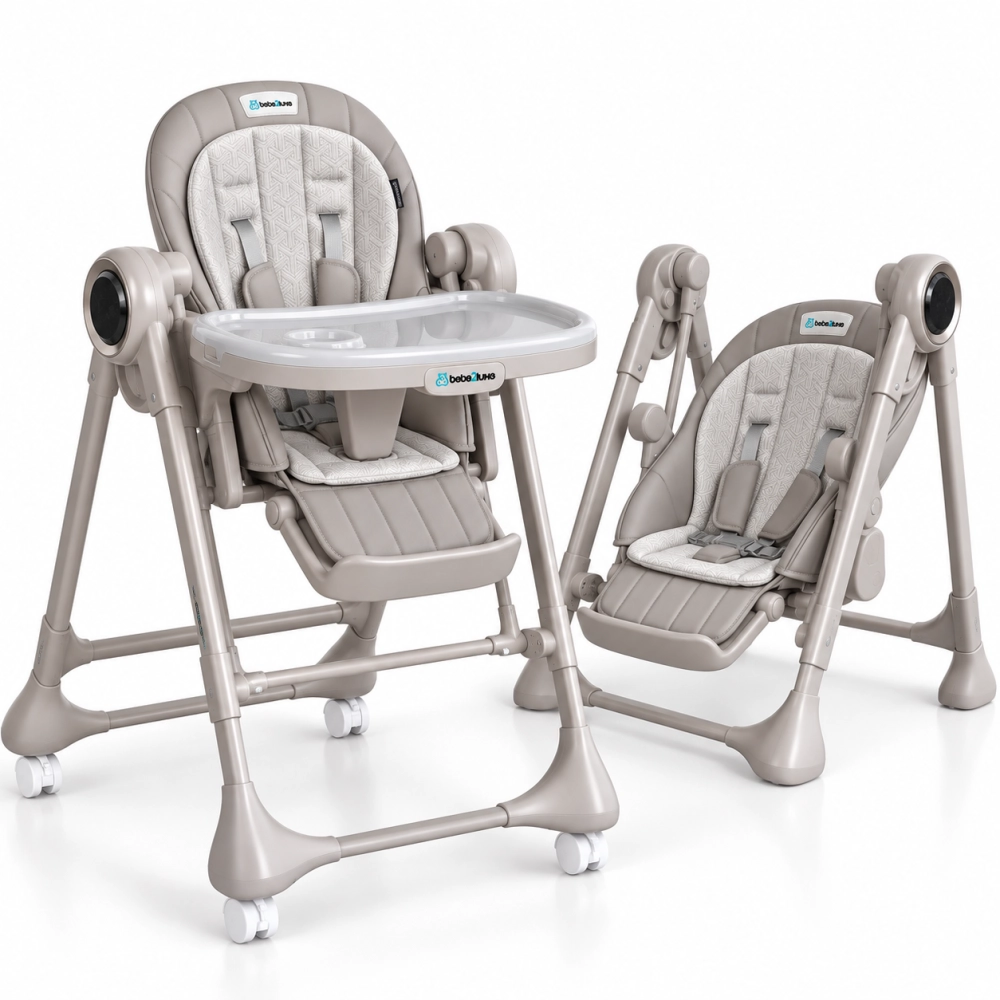
Around 6 months, when your baby can sit without help, the high chair becomes the best place to eat: they are at table height, well supported, and join in the family meal. What to check: a 5-point harness, an adjustable seat, a removable tray that is easy to wash, and a footrest so they are well settled. Our guide how to choose a baby high chair, and from what age covers all the criteria, and is a high chair good for babies? explains the right position at each age. For one purchase that lasts several years, consider a convertible high chair.
- SPLITY 3: bouncer and swing from birth, then high chair once the child sits unaided (around 6 months), up to 15 kg. 5-point harness, seat adjustable to 5 heights, removable double meal tray.
- Starwood: convertible wooden high chair, from 6 months to 5 years, with a 5-point harness. Find it in our wooden high chair section.
Small accessories that make all the difference
- Soft spoons, small and without hard edges, suited to your baby's mouth: our set of 4 silicone spoons.
- A bib with a pocket that catches what falls and goes in the dishwasher: the BABYHAPPY silicone bib.
- Fruit feeders, from 4 months, to let your baby taste a fruit or vegetable with no piece to swallow: our fruit feeder pacifier 2-pack, with three feeder sizes by age. To be used like any meal, baby seated and under your supervision.
All our mealtime accessories are in the feeding and breastfeeding section. Expecting a baby? Add them to your list now with our guide how to plan your baby registry.
FAQ: starting solid foods
At what age should you start solid foods?
Between 4 and 6 months completed: never before 4 months, and no later than 6 months, because milk alone is no longer enough after that. The right moment within this window depends on your child. For a premature baby, ask your paediatrician.
If I breastfeed, should I wait until 6 months?
No, the 4 to 6 month window is the same for breastfed babies. The first spoonfuls complement milk, they do not replace it: breastfeeding continues on demand.
Which food should you start with?
There is no longer a set order. Vegetables, fruit, starchy foods, meat, fish or egg can all be offered from the start, well cooked and blended into a smooth purée, with a teaspoon of oil and no salt.
When should you introduce egg, peanut and gluten?
From the start of solid foods, between 4 and 6 months. Delaying them does not prevent allergies. Egg is served well cooked, peanut and tree nuts as powder or smooth butter, never whole. If there are allergies in the family, ask your doctor first.
How many spoonfuls at the start?
One teaspoon, then a few more depending on appetite. At first, it's about tasting: milk remains the main food. Follow their hunger and fullness signals, without ever forcing them to finish.
When should you move on to lumps?
About two months after starting solid foods, often between 6 and 8 months: first mashed with a fork, then small, very soft pieces. Firmer pieces to chew are ideally offered between 8 and 10 months, and in any case before 1 year.
My baby refuses vegetables, what should I do?
Don't insist, but offer them again a few days later. A food often needs to be offered up to 8 or 10 times before it is accepted. Tasting it in front of them and keeping meals calm helps a lot.
When can a baby use a high chair?
Once they can sit unaided, usually around 6 months. Before that, give the first spoonfuls on your lap, baby well upright. Choose a high chair with a 5-point harness, and never leave your baby alone in it.
Can babies have honey or cow's milk?
Not before 1 year. Honey can transmit infant botulism, and cow's milk does not meet an infant's needs. After 1 year, choose whole milk or growing-up milk, never semi-skimmed before 3 years.
Should you give water when starting solid foods?
Yes, you can offer a little water at meals. Along with milk, it's the only drink your baby needs: no fruit juice or sweet drinks.
Sources: Santé publique France and Manger Bouger, "Pas à pas, votre enfant mange comme un grand" and "La diversification alimentaire de votre enfant jusqu'à 3 ans"; Santé.fr, "Tout savoir sur la diversification alimentaire de votre enfant" (2025) and "Commencer la diversification"; opinions of the French High Council for Public Health (2020) and Anses (2019). This article gives general guidance and does not replace the advice of your doctor or paediatrician, especially for a premature baby or if there are allergies in the family. Guidelines may vary slightly from country to country: follow those of your health professional.

SPLITY 3 – 3-in-1 Convertible High Chair, Bouncer & Baby Swing
- Lounger,Electric swing
- High chair with tray
- Save space and money

High chair StarWood natural
- 2 modes: high / low
- From 6 months to 5 years
- Comfort & Safety


